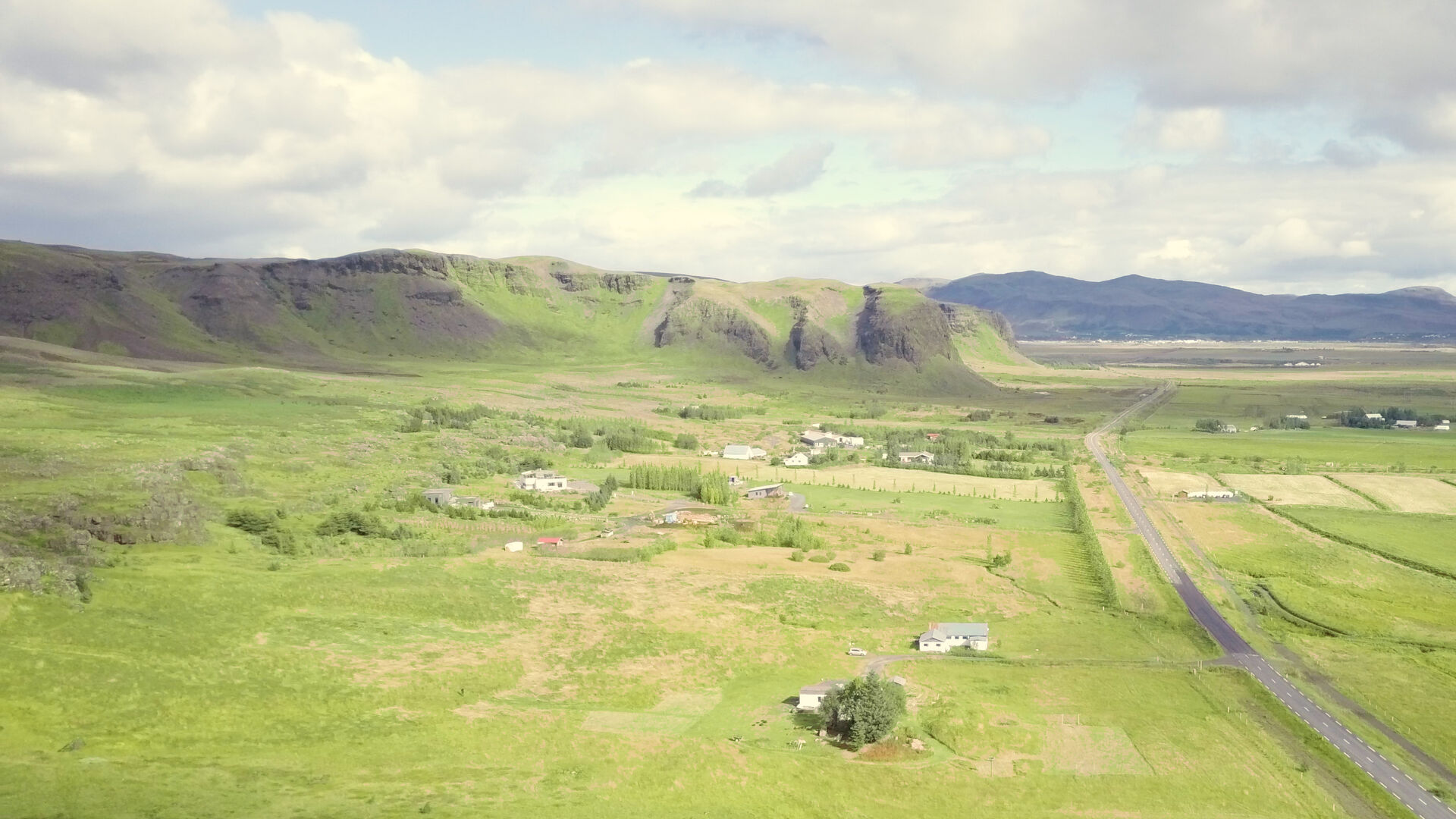
For sale · Ölfus, South Iceland · USD 3,300,000
Riftún: an 81-hectare geothermal estate in Iceland with an approved lagoon plan
Land 30 minutes from Reykjavík with plans in force for a bathing lagoon of up to 2,500 m², about 17,100 m² of greenhouses and 12 plots for holiday homes, on a documented geothermal system.
- Asking priceUSD 3,300,000Whole estate, as is
- Total area81.1 ha200 acres in three parcels
- Bathing lagoonup to 2,500 m²Approved plan in force (B 726/2022)
- Greenhouses / commercialabout 17,100 m²Buildable on plot A (34,200 m² × 0.5)
- Plots above the road12Holiday homes and houses (B 506/2025)
- Reykjavíkabout 30 minCity centre 40 min, Keflavík Airport 1 hour
Riftún is an 81.1-hectare (200-acre) estate in Ölfus, South Iceland, offered for sale at USD 3,300,000. To our knowledge it is the only land on the market in Iceland with a detailed plan in force for a geothermal bathing lagoon. The plan below the road (B 726/2022) permits a lagoon and hot tubs of up to 2,500 m², about 17,100 m² of greenhouse or commercial buildings and a plot for visitor activities, and the plan above the road (B 506/2025) adds 12 plots for holiday homes and houses. The land lies on the Bakki, Riftún and Þóroddsstaðir geothermal system, where nearby wells reach 120 to 125 °C at 600 to 800 m depth, and has cold-water springs. No well has yet been drilled to the deep system at Riftún itself, so the seller offers a purchase agreement conditional on drilling results.
Updated 4 October 2026 · Listing agent: Baldur Jezorski, licensed real estate agent in Iceland
Why Riftún
The slowest step is done
The master plan change and both detailed plans are approved and published in the Official Gazette. At Riftún that took from 2016 to 2025. A new lagoon site elsewhere would start from zero.
A documented geothermal system
Hot springs of up to 80 to 97 °C rose on and beside the land until about 1980, and wells on both neighbouring properties have produced water of 115 to 125 °C. ÍSOR (Iceland GeoSurvey) found a hot strip running across Riftún.
Room for a whole destination
Lagoon and spa, greenhouses with a restaurant, horse riding, and 12 plots for cabins or houses: enough for a destination that keeps guests for a day or several nights, not just a swim.
30 minutes from Reykjavík
Close to the main route to the Golden Circle and South Coast, 7 km from Hveragerði, and outside the Reykjanes eruption zone that has repeatedly closed the Blue Lagoon since 2023.
Verify before you commit
The seller is willing to sign a purchase agreement that becomes binding only if the buyer is satisfied with the drilling results. The central uncertainty is resolved before the money is.
Heat used twice
Geothermal water can heat greenhouses first and then the lagoon, cutting the cold water needed for cooling. Spring water on the land adds options for bottling or supplying neighbours.
The land: three parcels, 81.1 hectares
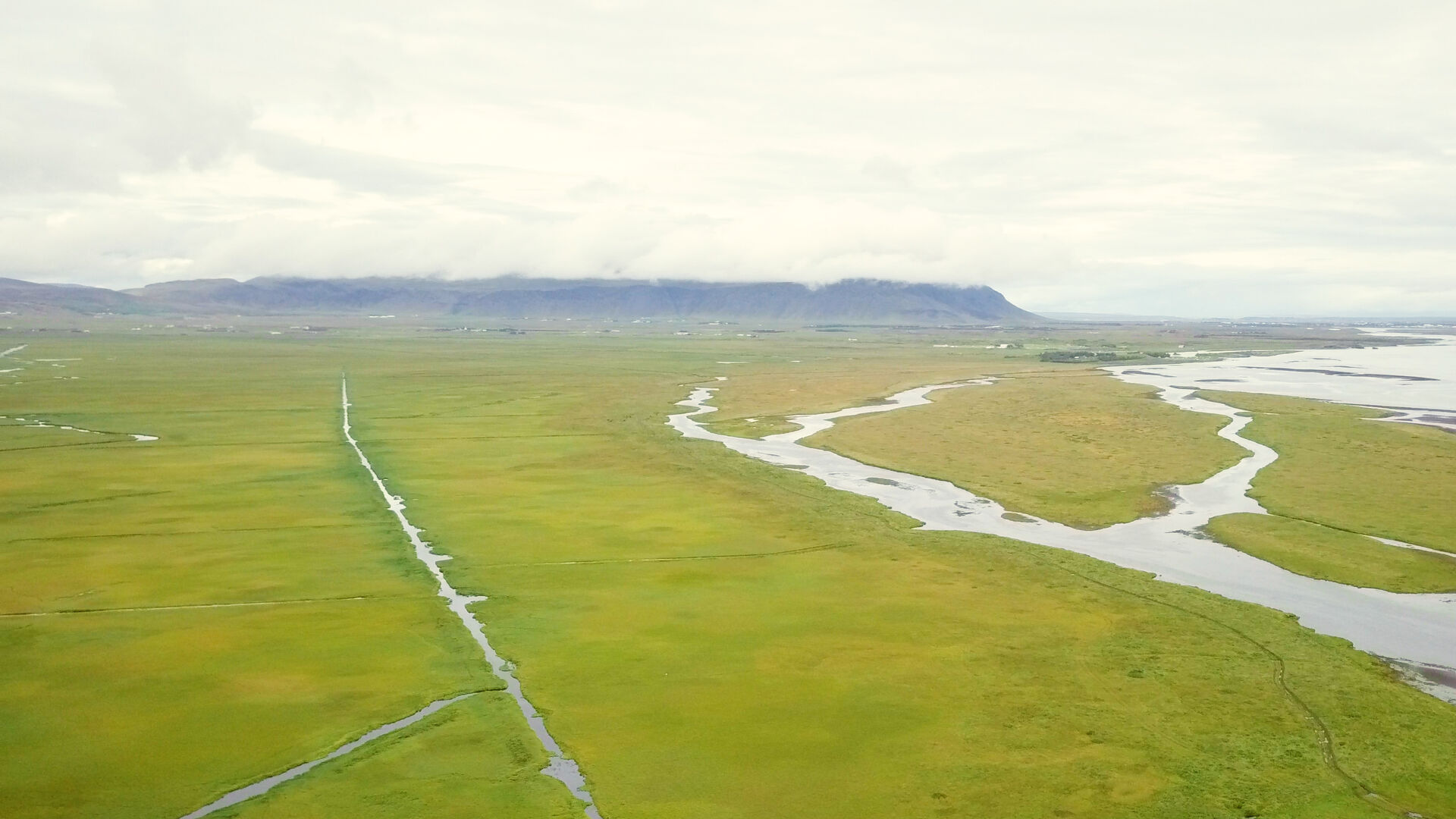
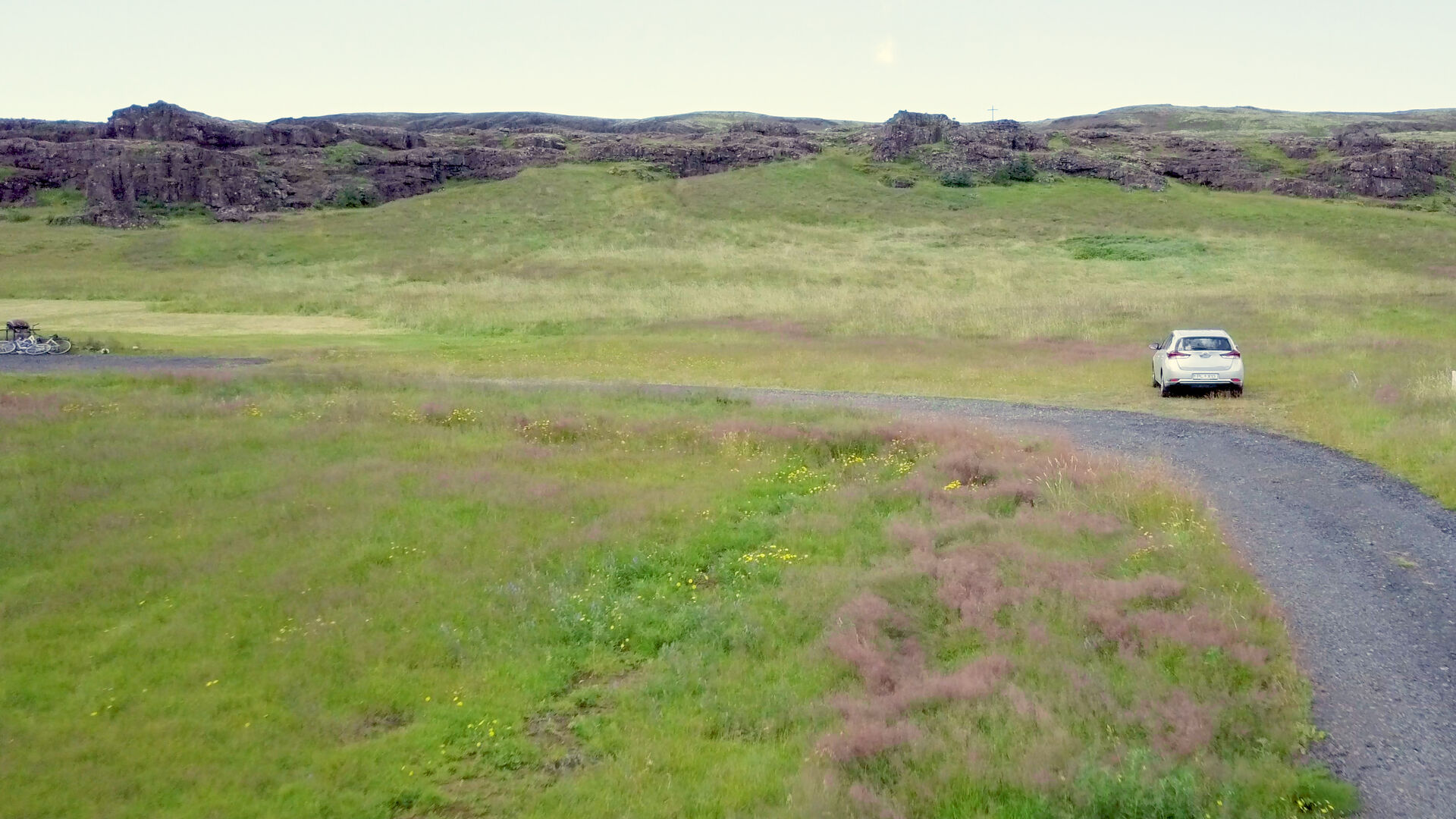
Riftún stretches from the moss-covered lava cliffs above Þorlákshafnarvegur (road 38), across meadows and a farmstead, down to the wetlands and the Varmá river. All three parcels are registered to the seller in the HMS property register; registry certificates showing any easements or mortgages are being obtained for buyers.
| Parcel | Registration | Area | Where | Plan | Notes |
|---|---|---|---|---|---|
| Riftún | F221-1898 L171796 | 29.8 ha | Above Þorlákshafnarvegur (road 38), up to the lava cliffs | Detailed plan B 506/2025: 12 plots for holiday homes and houses | Farmhouse of 173 m² (built 1965), old borehole RT-1, access road |
| Riftún 3 | F234-3703 L204631 | 9.3 ha | Below the road | Detailed plan B 726/2022: lagoon, greenhouses, tourism, parking | Commercial and service area V21 in the Ölfus master plan |
| Riftún 4 | F234-3704 L204632 | 42.0 ha | Below the road, down to the Varmá river | No detailed plan; largely within the flood-hazard area | Wetlands, river frontage and the zone of the former hot springs |
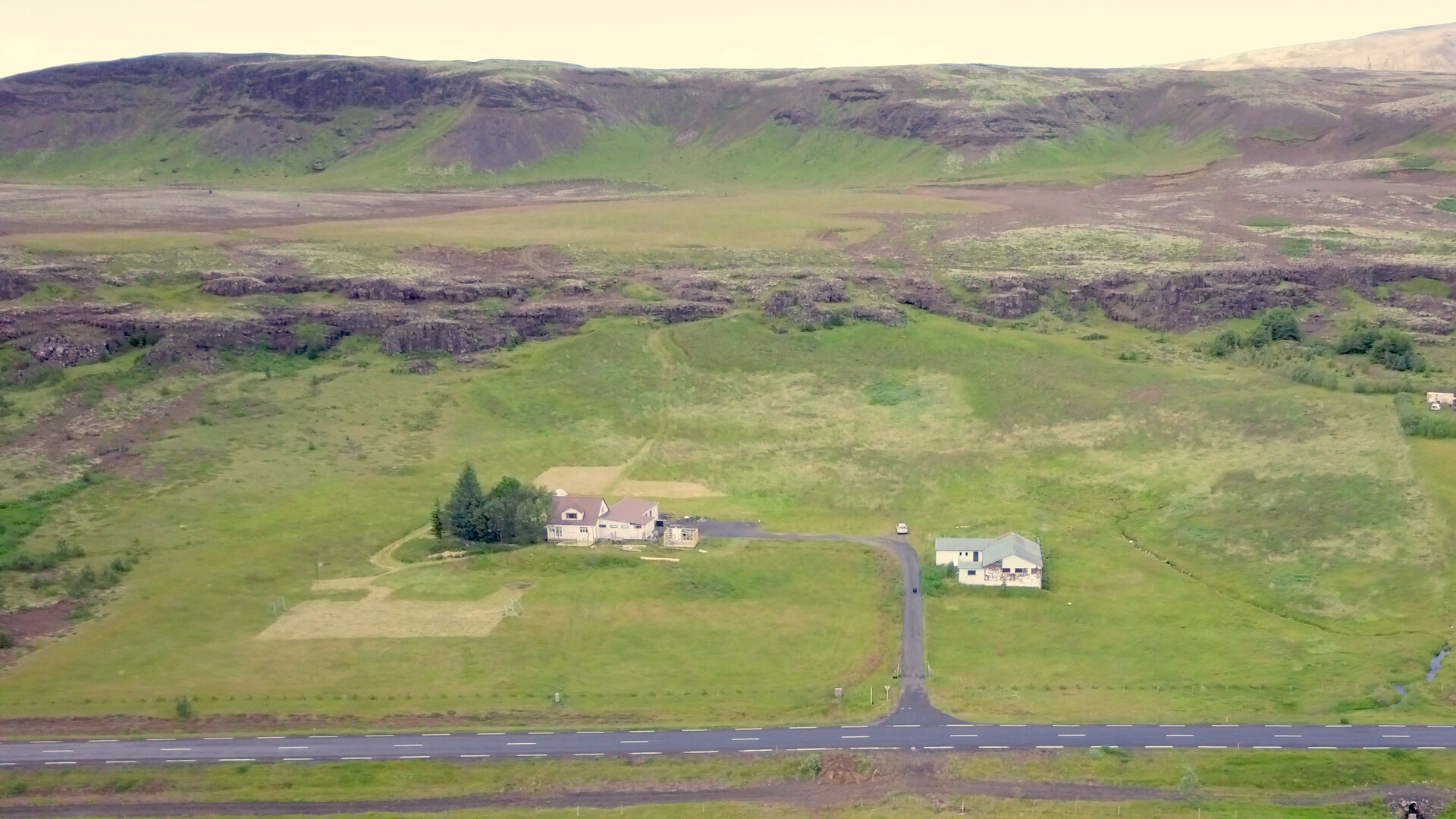
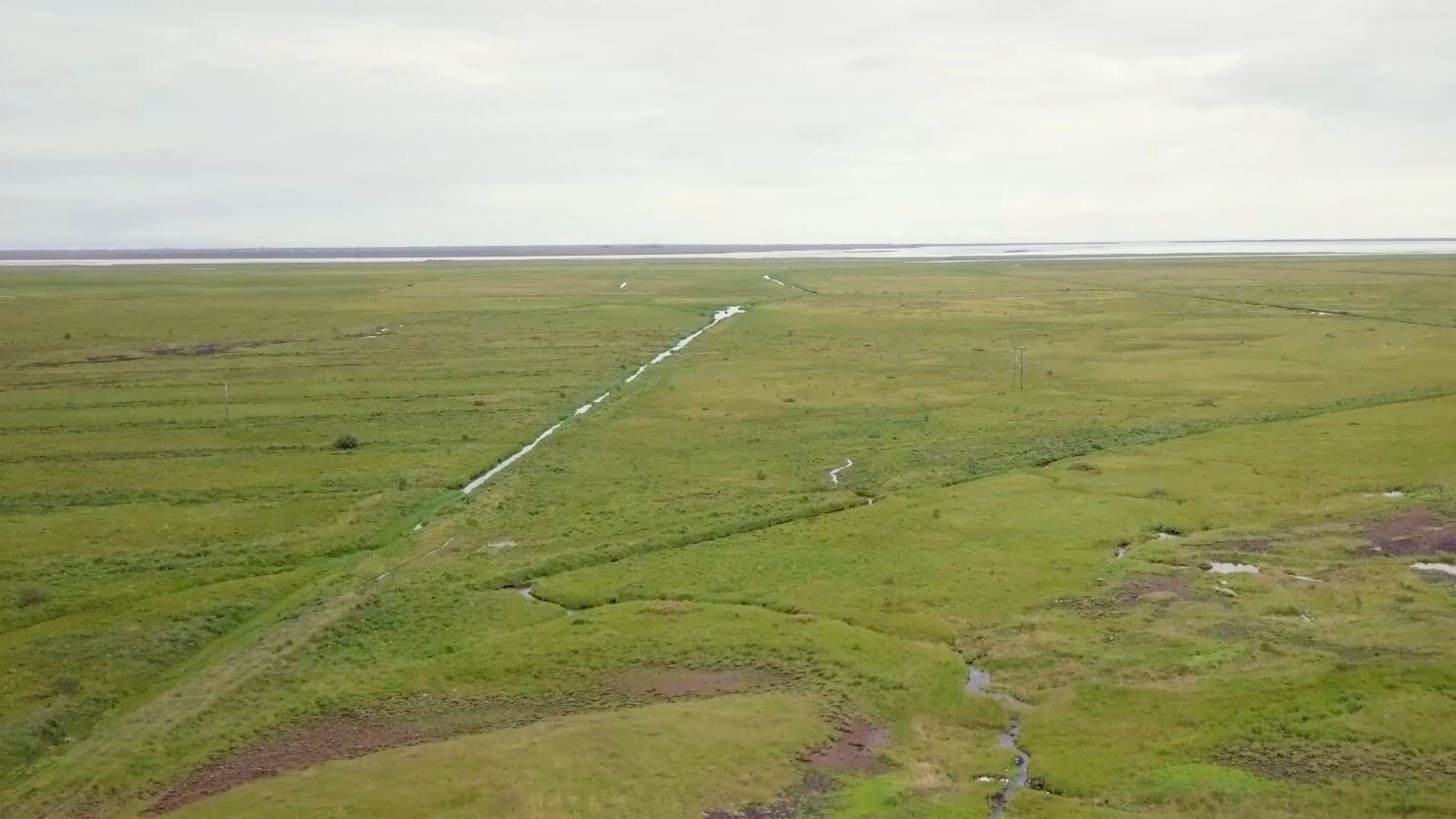
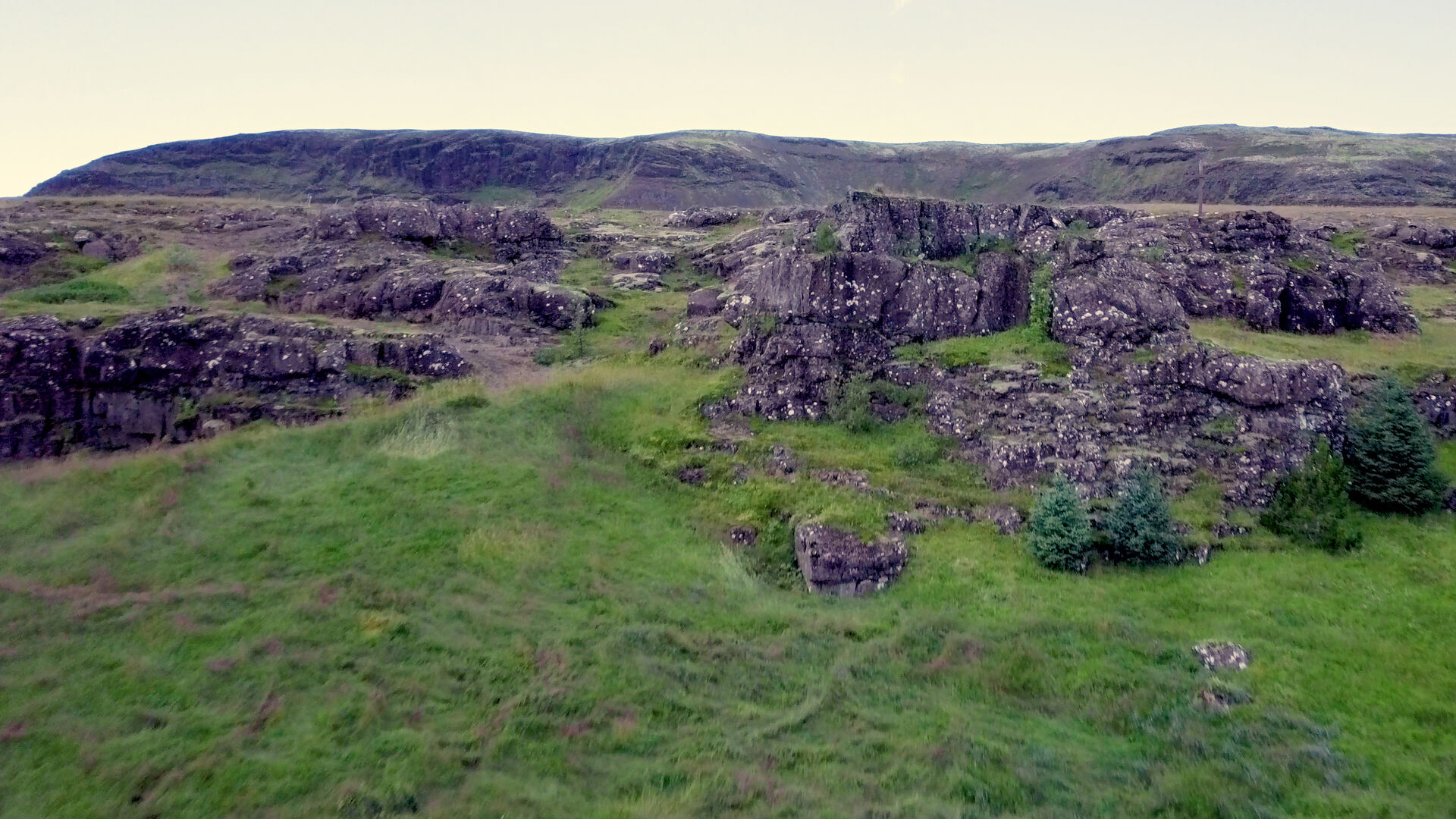
Approved plans: lagoon, greenhouses and holiday homes
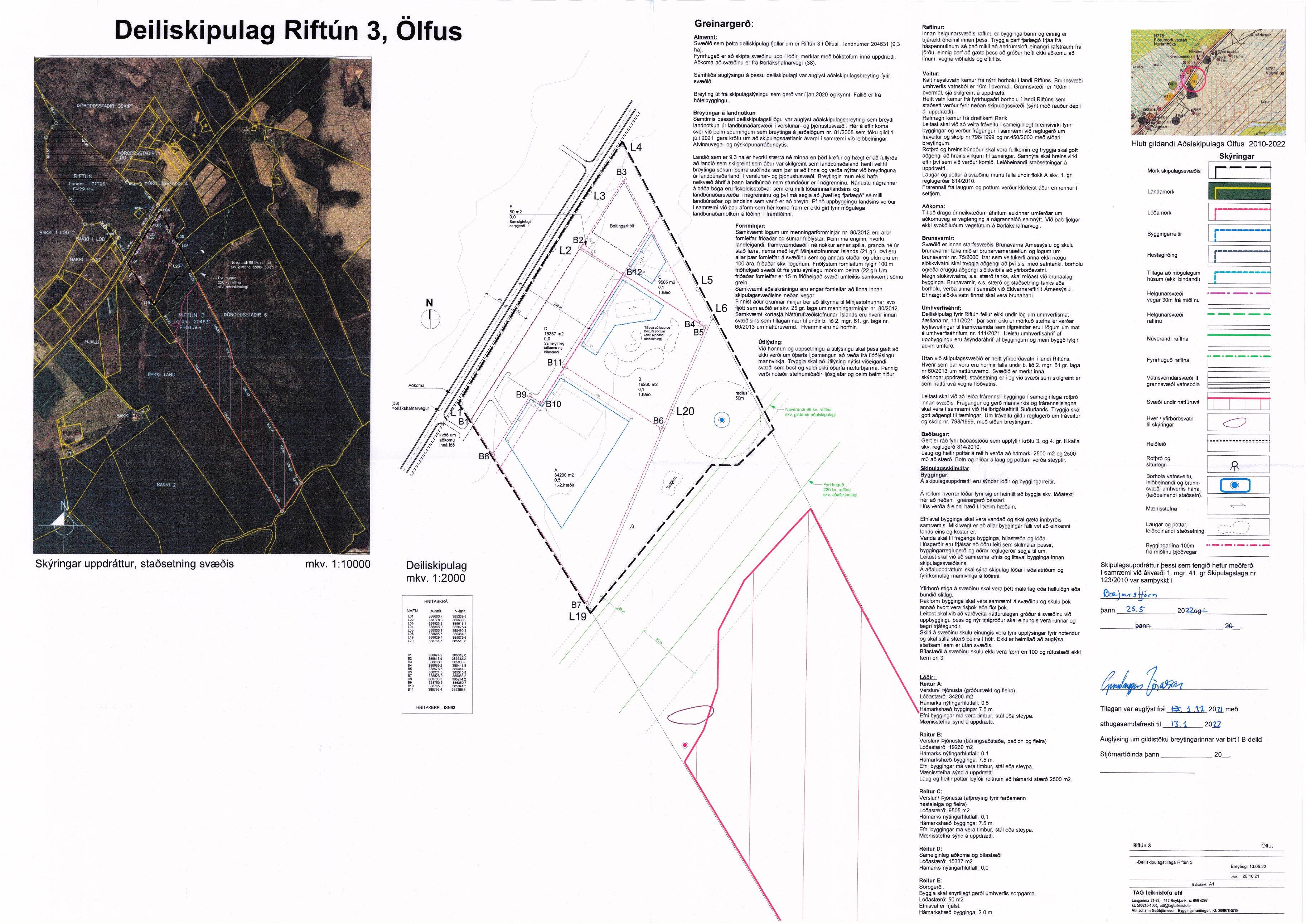
Planning approval is the step that usually takes longest in Iceland. At Riftún the master plan for Ölfus was amended to create a commercial and service area (V21) for tourism, greenhouse cultivation and a bathing lagoon, and two detailed plans are in force.
Below the road: Riftún 3 (9.3 ha), plan B 726/2022
| Plot | Use | Plot area | Site coverage | Buildable |
|---|---|---|---|---|
| A | Horticulture, retail and services (greenhouses) | 34,200 m² | 0.5 | about 17,100 m² |
| B | Bathing lagoon, hot tubs, changing facilities and services | 19,260 m² | 0.1 | about 1,926 m² of buildings, plus a lagoon of up to 2,500 m² / 2,500 m³ |
| C | Visitor activities, e.g. horse rental | 9,505 m² | 0.1 | about 950 m² |
| D | Shared access and parking (at least 100 cars and 3 coaches) | 15,337 m² | 0 | none |
| E | Waste enclosure | 50 m² | enclosure only |
Buildings up to 7.5 m high; at least 100 parking spaces and 3 coach spaces; shared access from road 38; bathing facilities of class A under Regulation 814/2010. Buildable areas are calculated from plot area times site coverage ratio.
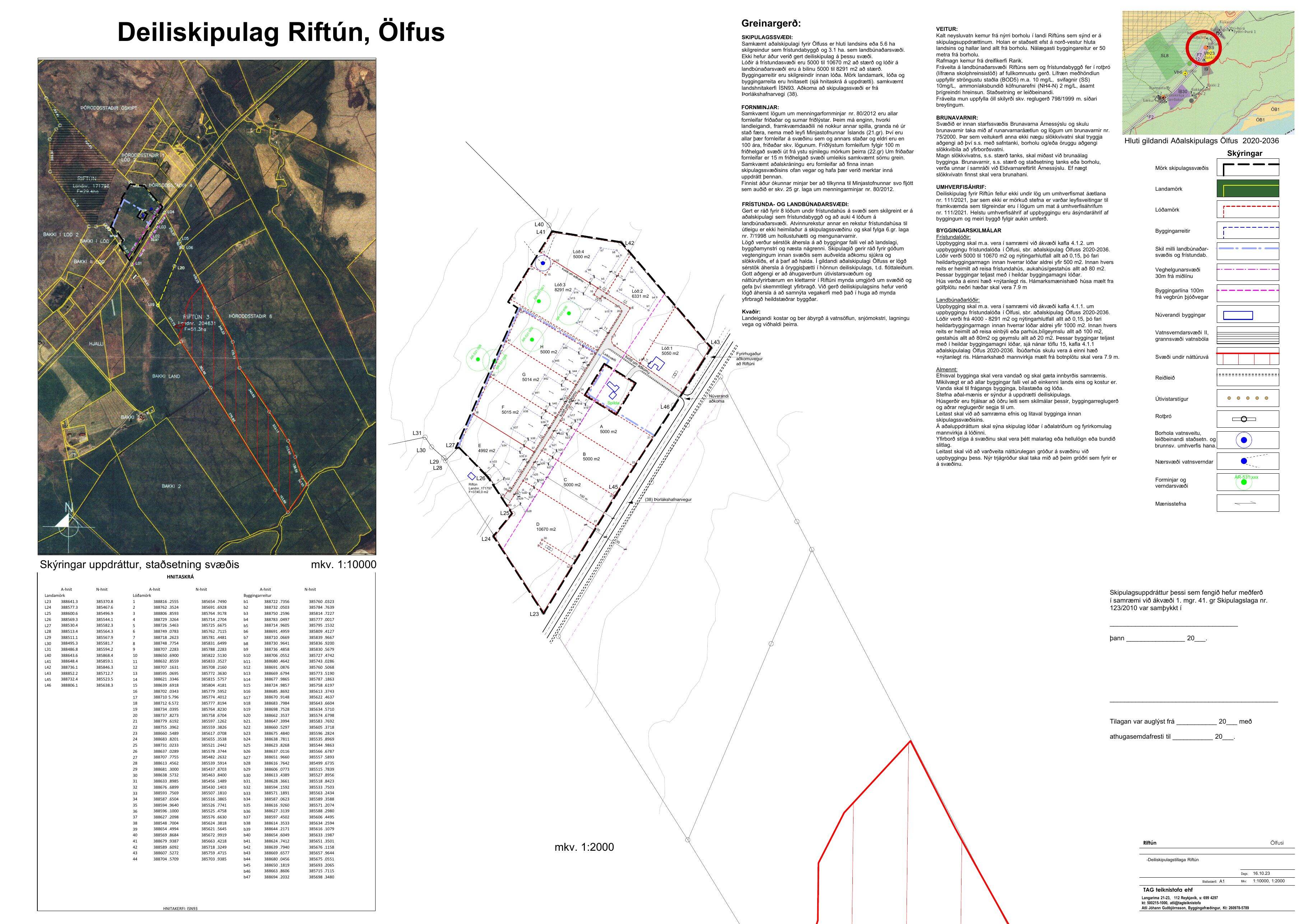
Above the road: Riftún (29.8 ha), plan B 506/2025
Twelve plots: the published notice describes 9 holiday-home plots and 3 house plots. Holiday-home plots of 5,000 to 10,670 m² may carry up to 500 m² of buildings each, including a guest house of up to 80 m²; house plots may carry up to 1,000 m², including a garage, guest house and store. Buildings are one storey with a usable attic, up to 7.9 m high, and renting out holiday homes is permitted.
Planning timeline
- 2016ÍSOR (Iceland GeoSurvey) assesses the geothermal prospects at Riftún (report ÍSOR-16039). The owner asks Ölfus to change the land use to tourism.
- 2018EFLA Consulting Engineers models uses of the resource: hot-water sales, a bathing lagoon and power generation.
- 2020Ölfus grants a development permit for three geothermal research wells, 800 to 1,500 m deep (unused; renewal needed).
- 2022Master plan amendment (B 535/2022) creates commercial and service area V21 for tourism, greenhouse cultivation and a bathing lagoon. Detailed plan below the road approved 25 May and in force (B 726/2022).
- 2025Detailed plan above the road approved 27 March and in force (B 506/2025): holiday-home and house plots.
- 2026Minor amendment to the plan boundaries (B 914/2026) alongside the new Þorlákshafnarvegur road plan. Riftún offered to investors.
Official Gazette notices: B 535/2022 (master plan, 6 May 2022) · B 726/2022 (below the road, 20 June 2022) · B 506/2025 (above the road, 15 May 2025) · B 914/2026 (plan boundaries, 25 August 2026).
Geothermal resource: what the research shows
Riftún sits in the Bakki, Riftún and Þóroddsstaðir low-temperature geothermal system, which has heated the town of Þorlákshöfn since 1979. The evidence comes from ÍSOR (Iceland GeoSurvey, 2016), the National Energy Authority (1990) and EFLA Consulting Engineers (2018).
| Hot springs on the land | Up to 80 °C at the Bakki boundary and up to 97 °C just east of Riftún, until production began around 1980 |
|---|---|
| Borehole RT-1 at Riftún (1970) | 349 m deep; water above 50 °C at 305 to 336 m; repairable to give up to about 4 l/s |
| Nearby wells | Over 120 °C at 600 to 800 m in all of them; 125 °C in the two nearest (Þóroddsstaðir and Eystribakki); yields of about 8 to 15 l/s per well |
| The system as a whole | Estimated to support more than 100 l/s at about 120 °C; the utility Veitur already produces about 38 l/s from wells 0.5 to 1 km away |
| ÍSOR's conclusion | "Below 600 to 800 m depth a water system of up to 125 °C may be found", with permeability depending on intersecting fissures |
| Seller's expectation | Water of about 110 to 130 °C at 800 to 1,200 m; not guaranteed until drilled |
| Drilling quotations | Contractor quotations for 1,000 and 1,200 m wells are included in the document pack |
What only drilling can answer
No study quantifies what a new well at Riftún will produce. EFLA's model, pro rata, implies that a 2,500 m² lagoon in design winter conditions needs roughly 89 l/s of 100 °C water or about 69 l/s at 120 °C, which is more than one typical well in the area yields. A buyer should therefore plan for more than one well, a phased lagoon or cascaded use of the heat, and can make the purchase conditional on the results. Research drilling needs a municipal permit (granted in 2020 for three wells and due for renewal) and a research permit from the Environment and Energy Agency.
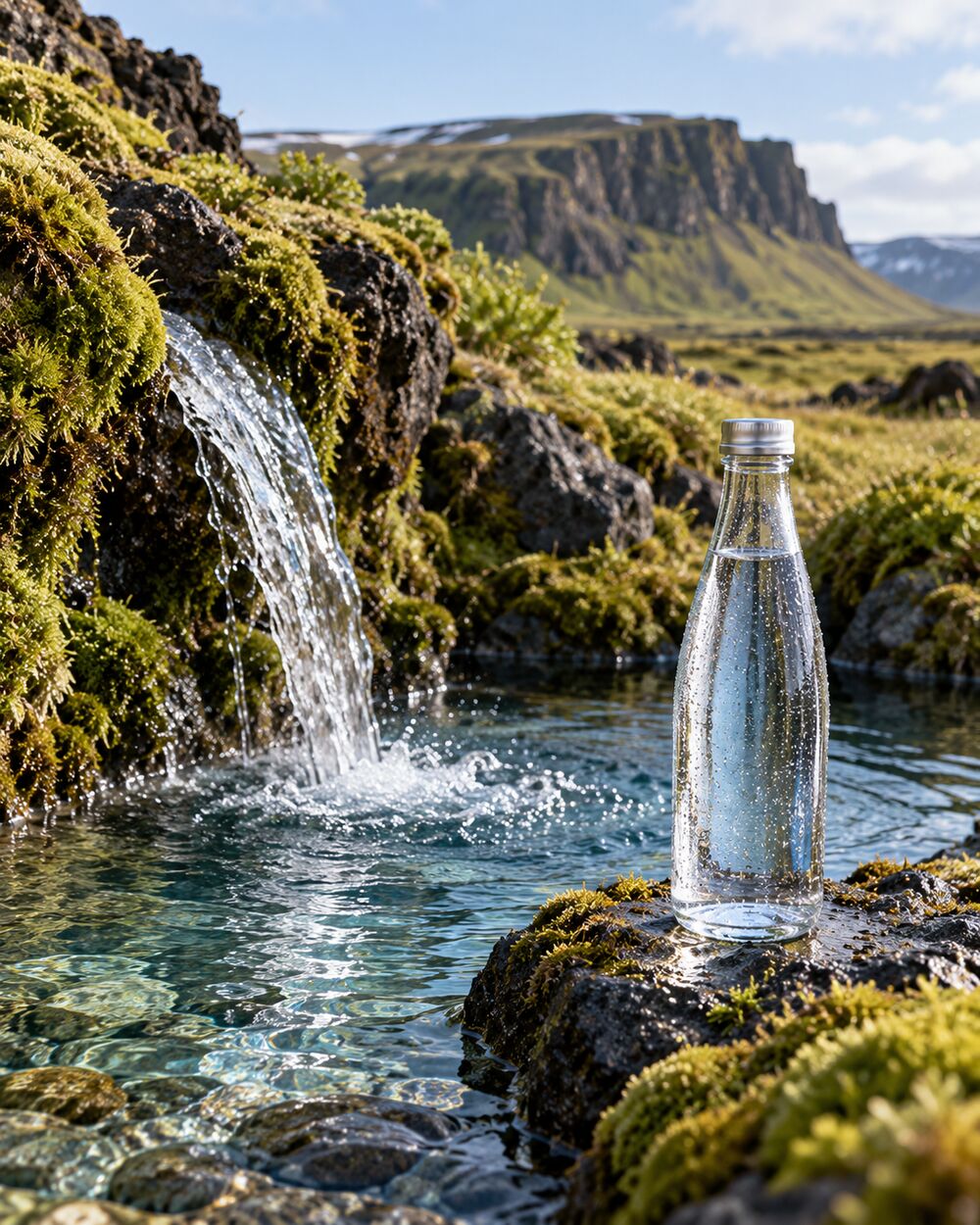
Cold water and springs
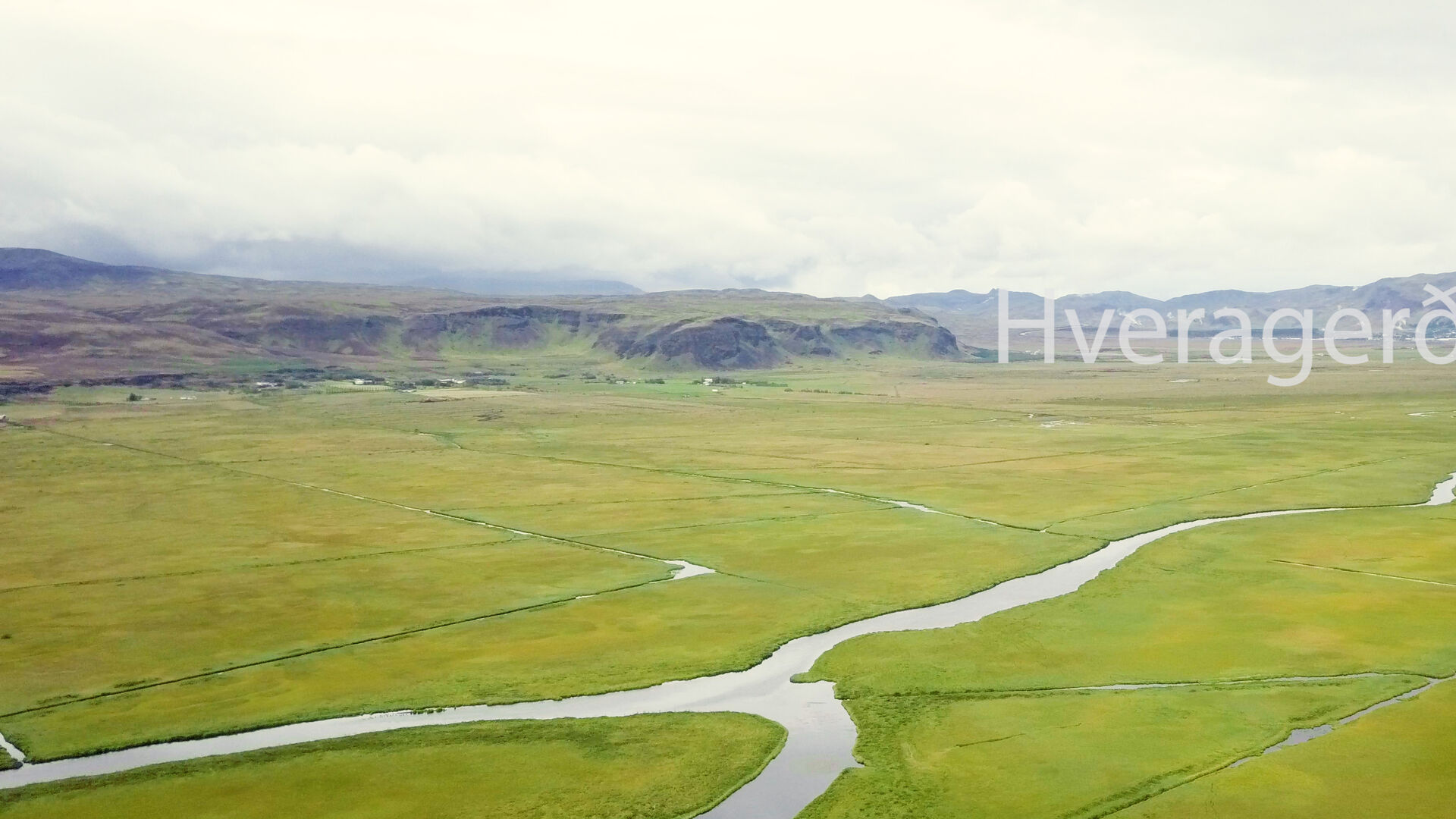
Spring water issues from the young grey basalt at the foot of the escarpment. Two springs on the Riftún side of the Bakki boundary measured 32.5 l/s at 4.1 to 4.2 °C on 4 August 1986, and the Ölfus master plan states that the spring areas at Riftún, Þóroddsstaðir and Vötn together yield more than 100 l/s. The same aquifer supplies neighbouring fish-fry stations. There are no recent measurements; a buyer can pump-test the springs during the inspection period. Cold water matters for a lagoon because mixing is the simplest way to cool geothermal water, so the water balance should be designed with heat exchangers or greenhouse heating in mind.
Development potential
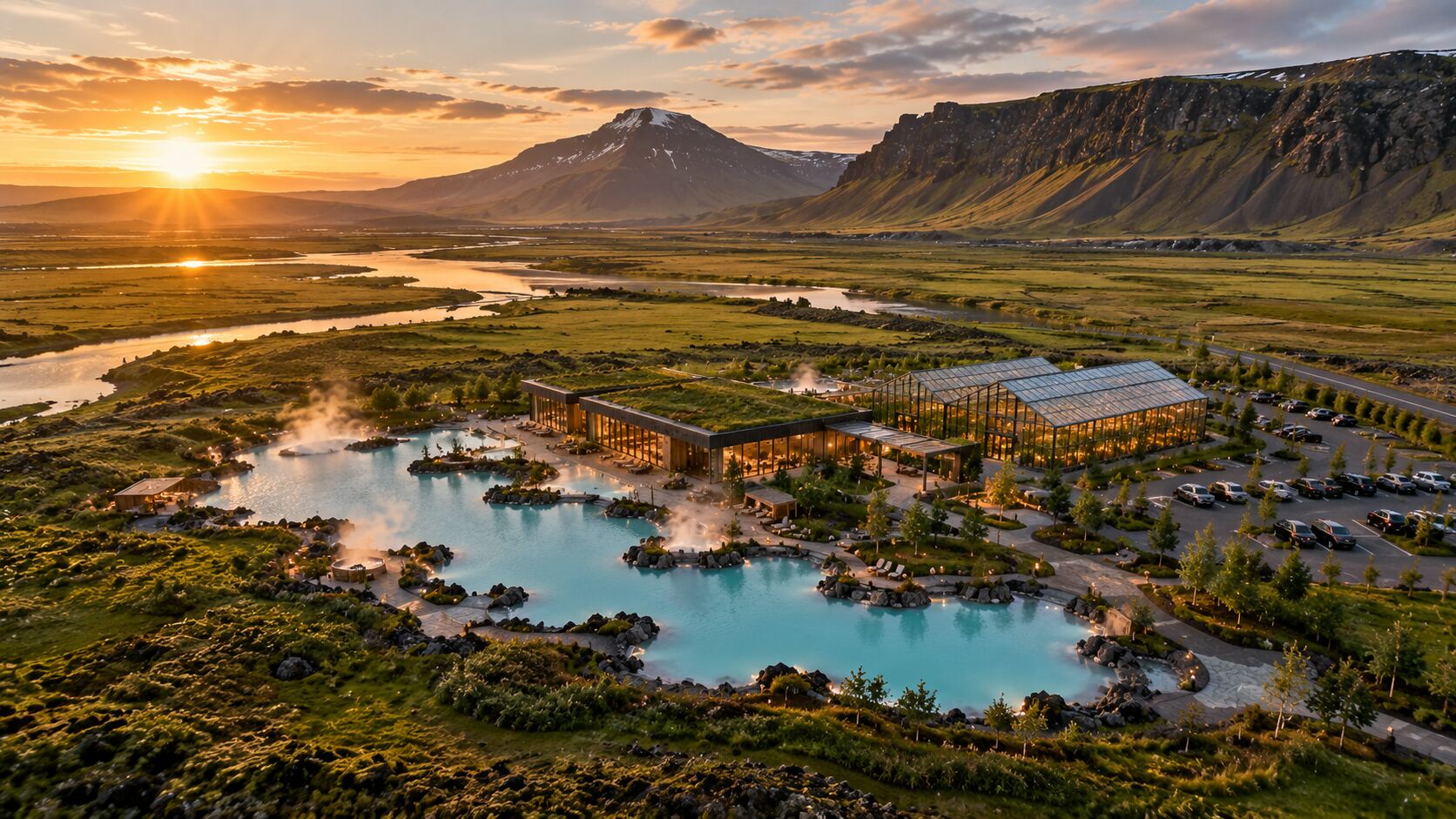
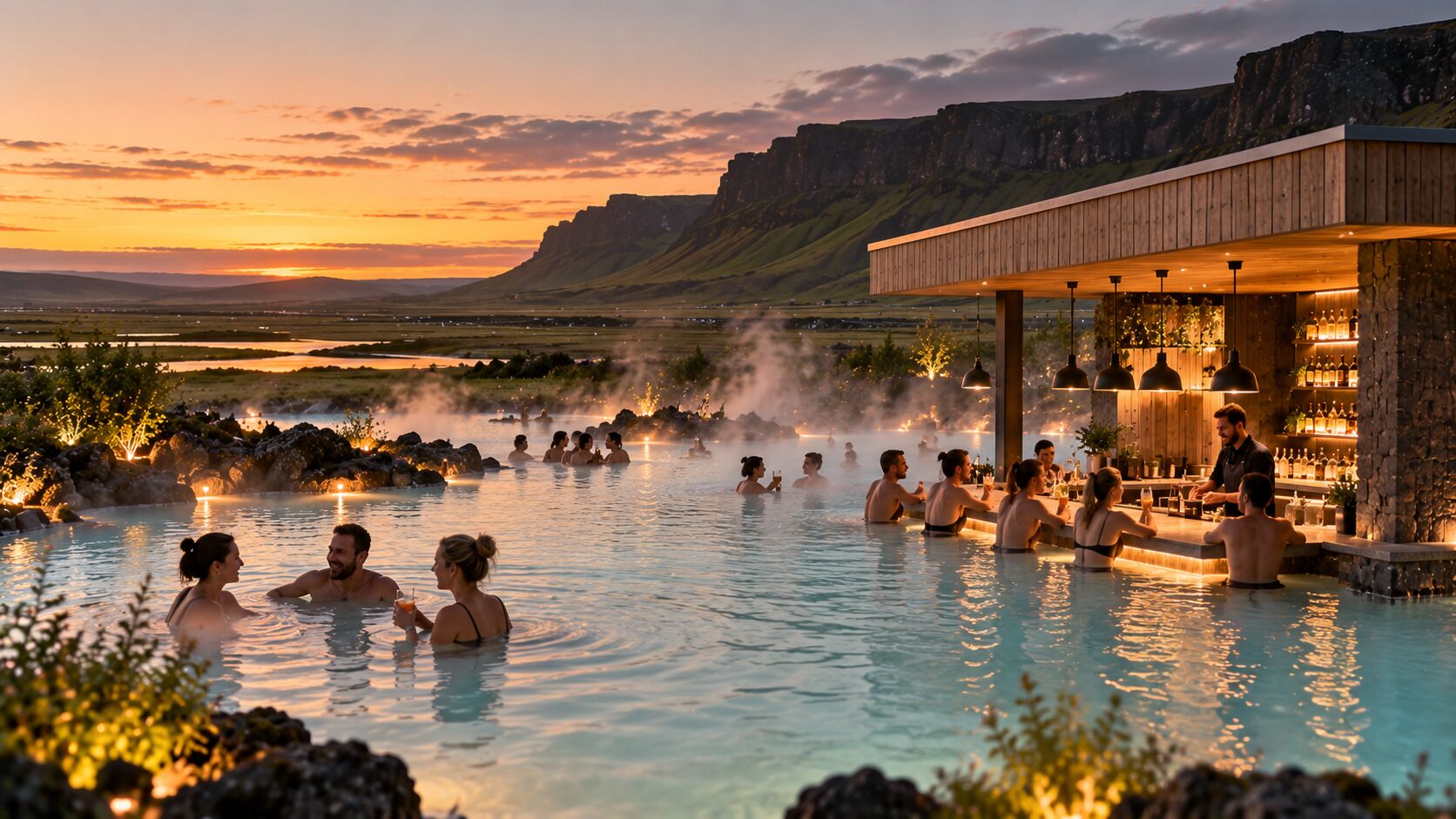
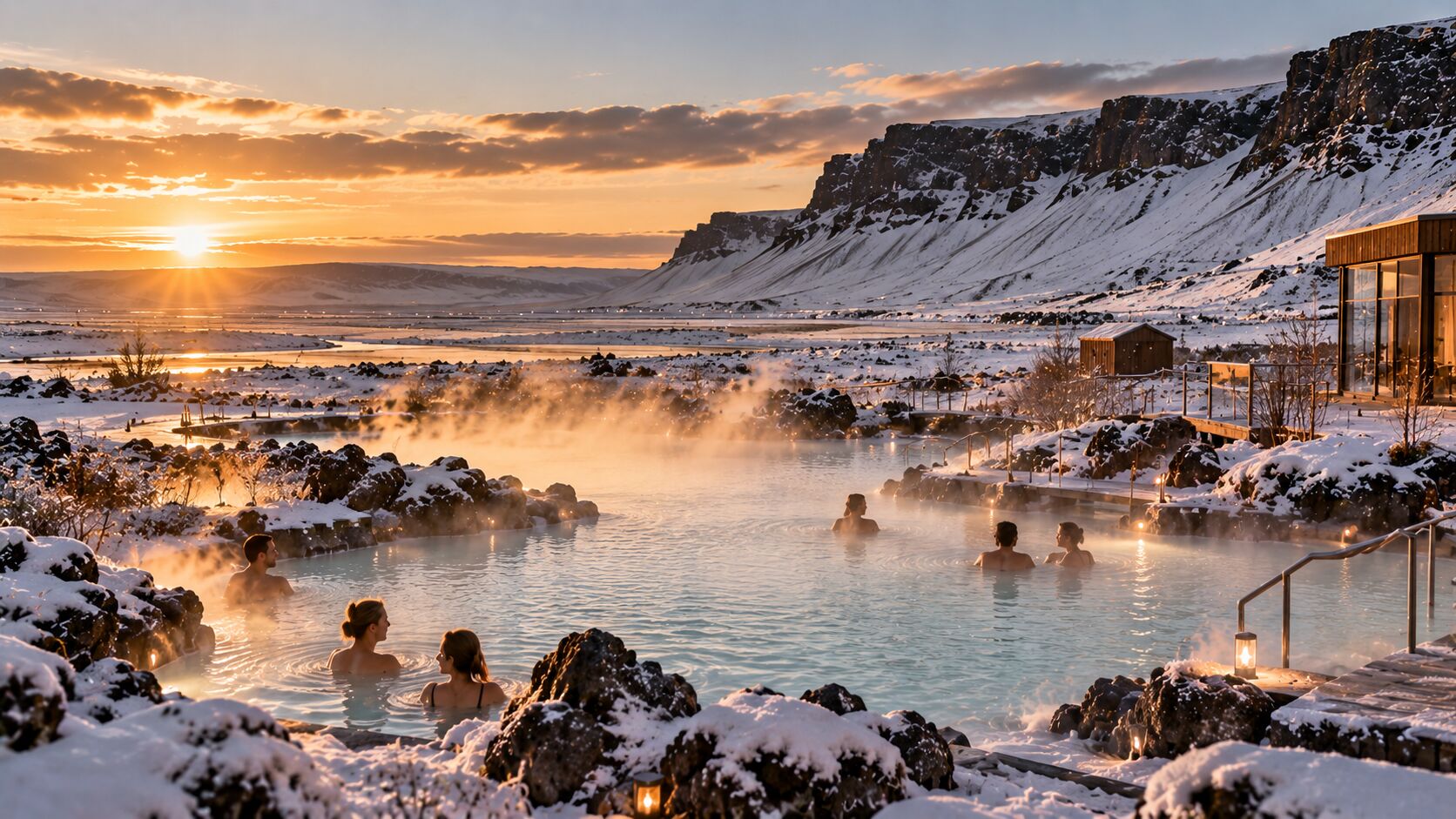
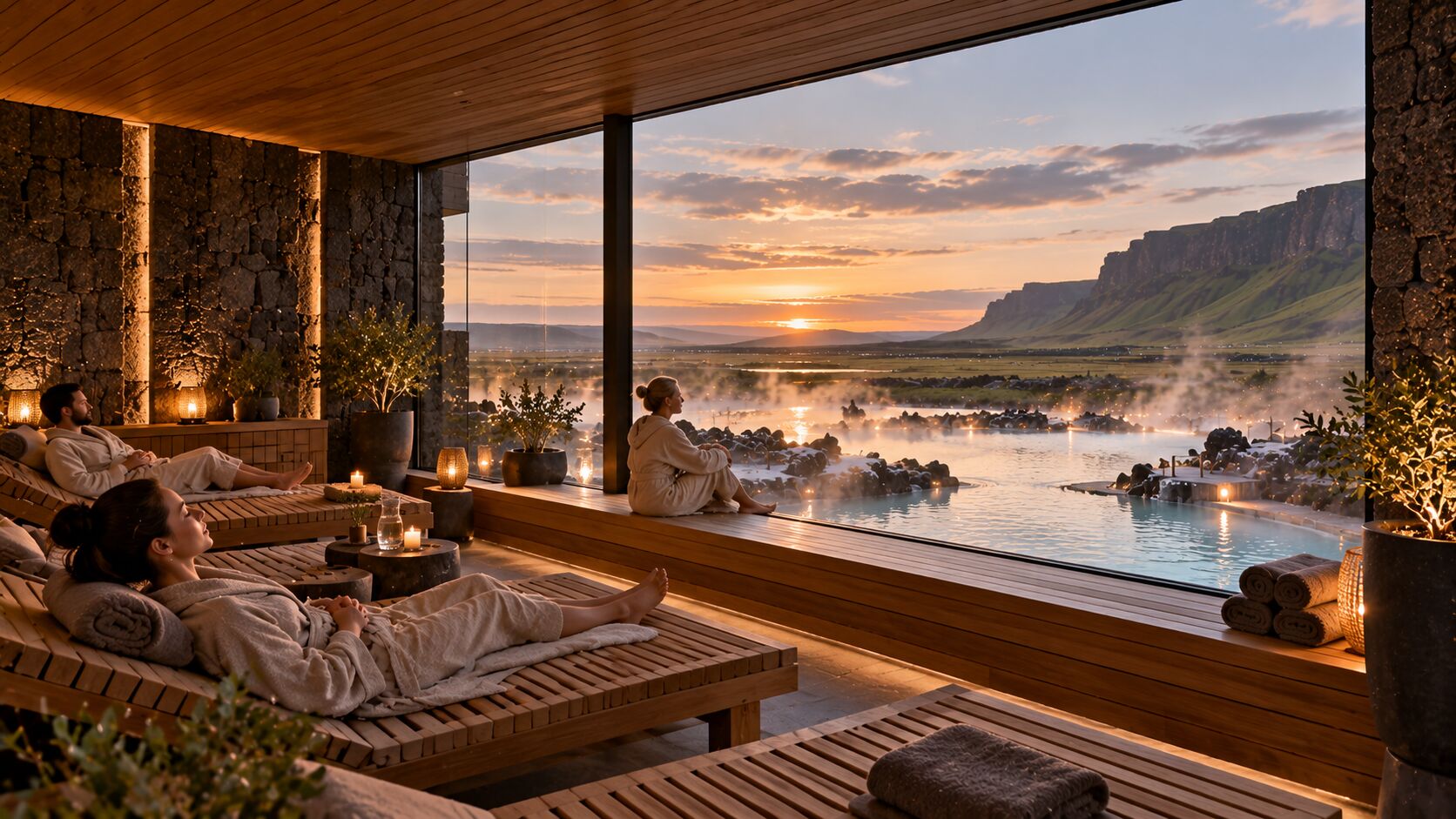
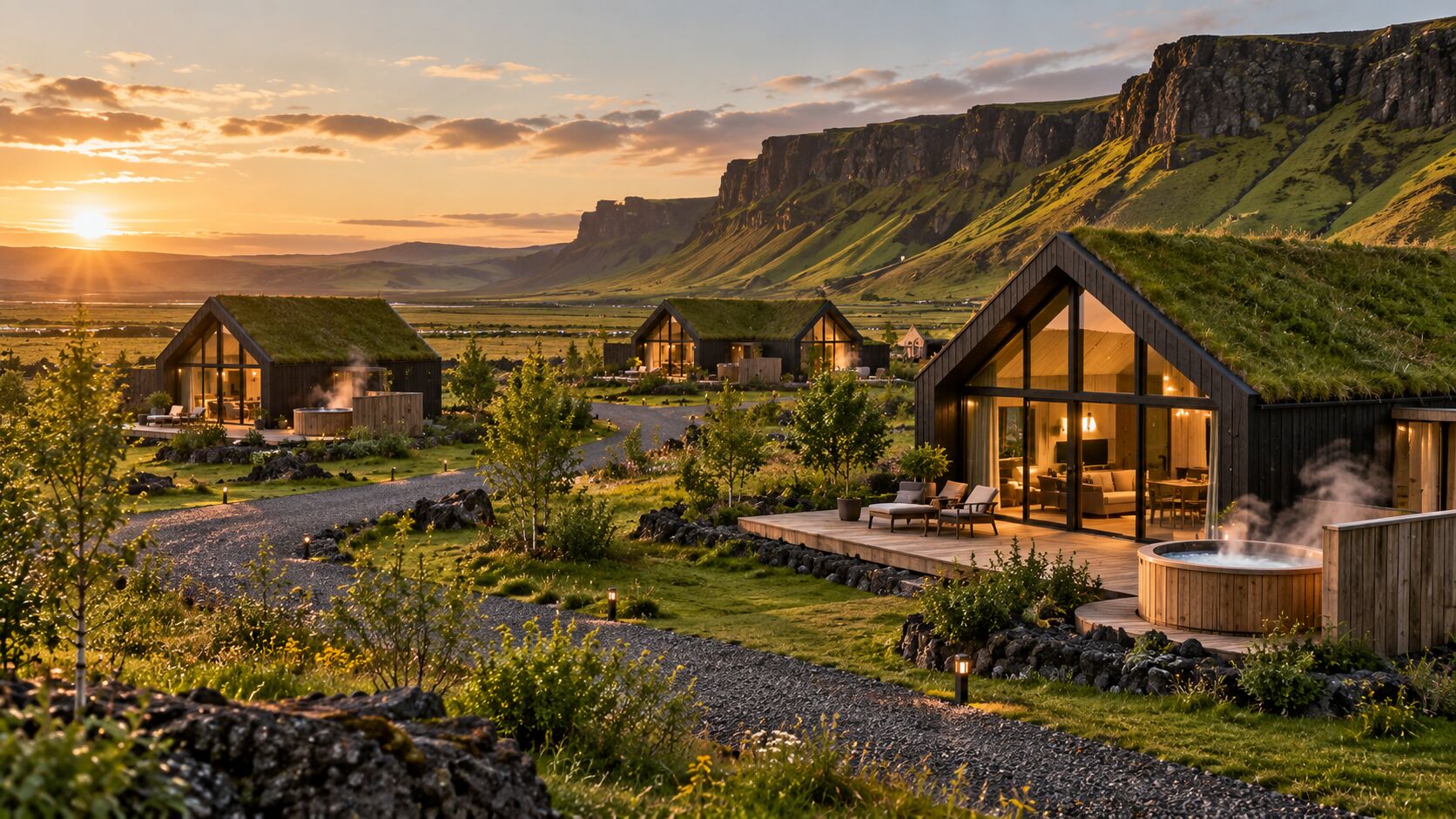
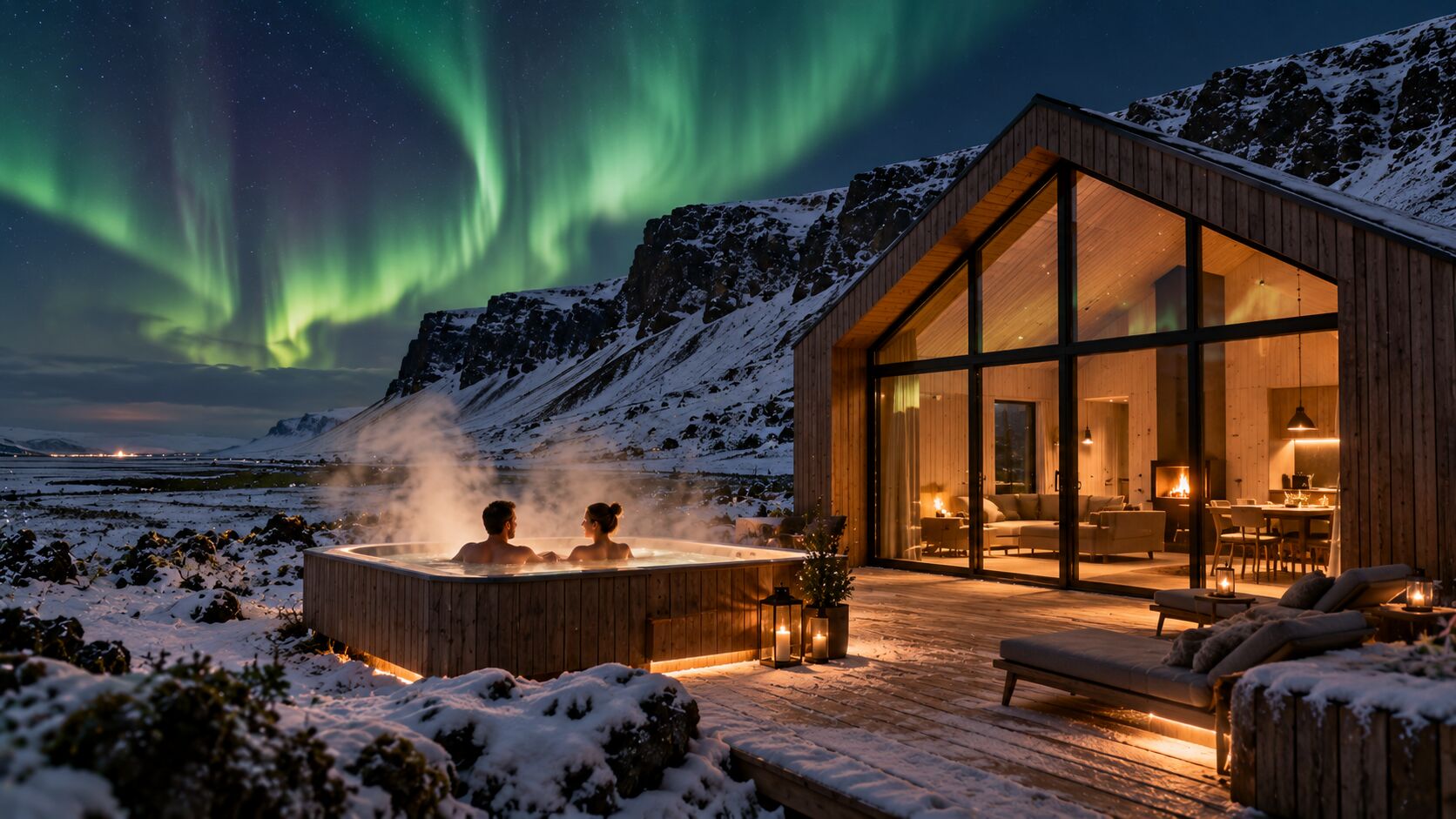
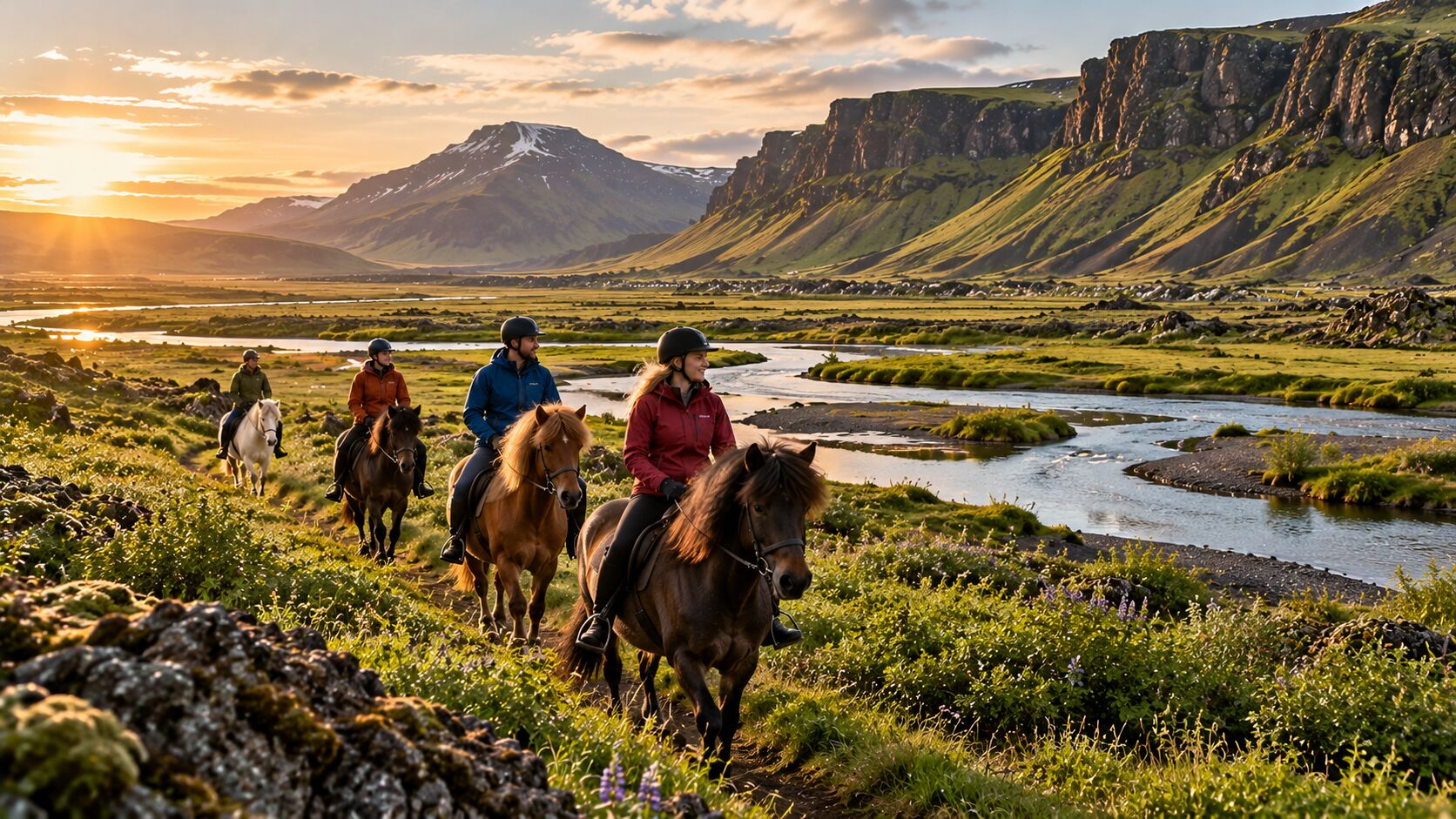
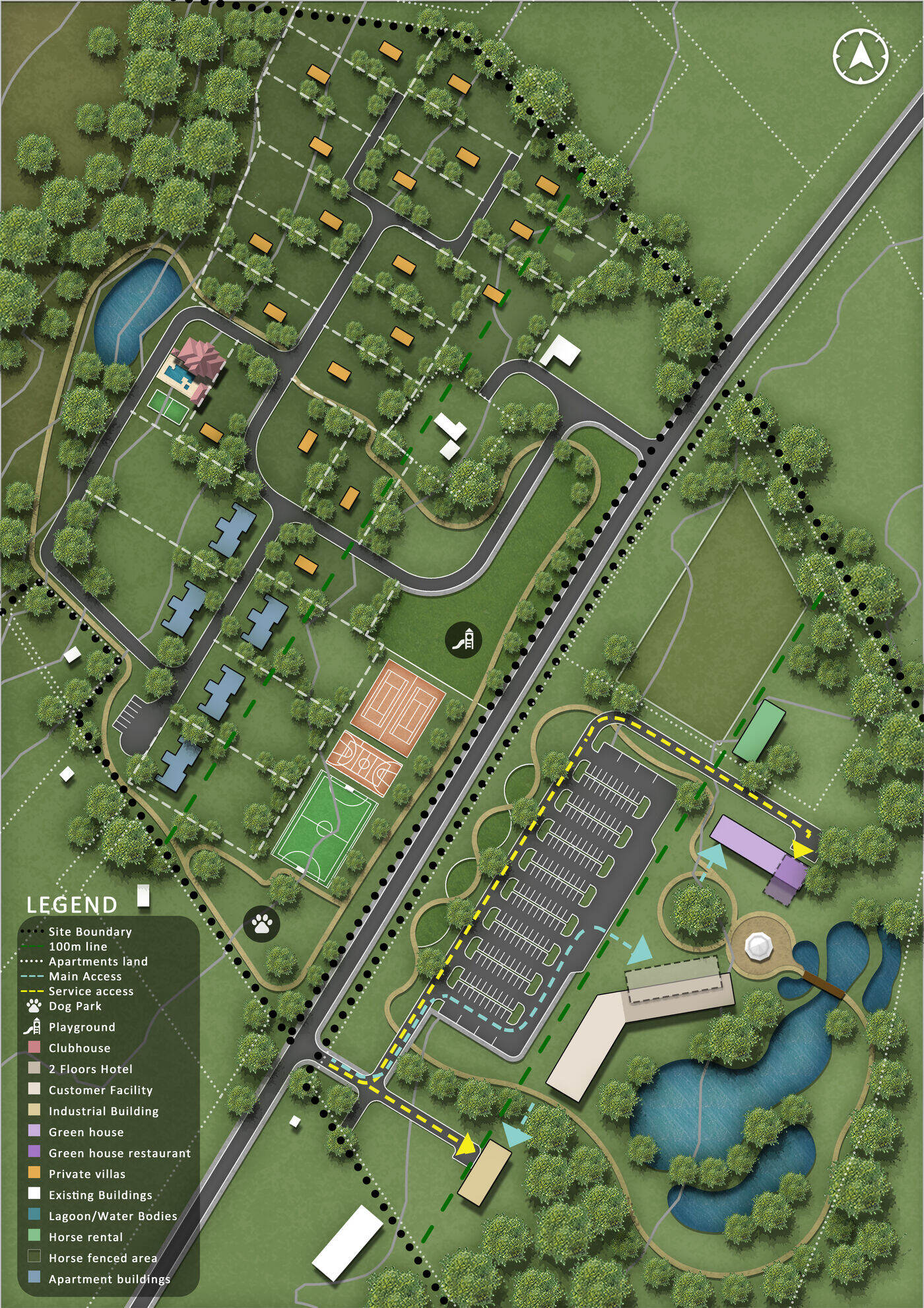
The approved plans support a combined destination: a geothermal lagoon and spa on plot B, greenhouses on plot A that can house food production, a restaurant or a food hall, visitor activities such as Icelandic horse riding on plot C, and holiday homes or houses for rent above the road. The images below are concepts that show the atmosphere a developer could create; they are not designs for the site and do not show the actual project.


Ideas investors have explored
- A lagoon and spa close to Reykjavík, open all year, with winter evenings under the northern lights.
- A greenhouse restaurant and farm shop in the style of Friðheimar, heated by the same water as the lagoon.
- Luxury cabins or turf-roof holiday homes with private hot tubs on the plots above the road.
- Commercial greenhouses for vegetables, berries or flowers, using geothermal heat.
- Bottled spring water or water and heat supply to neighbouring aquaculture, subject to permits.
- Horse riding and bird-watching trails across the wetlands to the Varmá river.
The lagoon market in Iceland
- Commercial lagoons182025, up from 14 in 2021
- Revenue, 10 largest operatorsUSD 218 m2024, ISK 26.6 bn (PwC)
- Foreign visitors who batheabout 57%Icelandic Tourist Board
- EBITDA margins, established lagoons28 to 46%2025 annual accounts
Sky Lagoon, which opened near Reykjavík in 2021, had revenue of about USD 54 million (ISK 6.6 billion) and net profit of USD 12.8 million in 2025, and mid-sized lagoons such as Forest Lagoon, Hvammsvík and Mývatn each earned USD 9.5 to 11 million with EBITDA margins of 34 to 42%. Recent lagoons cost about USD 16 to 41 million (ISK 2 to 5 billion) to build, and the bottleneck for new entrants is planning approval, which Riftún already has. Read: the lagoon business in Iceland, with 2025 results from the annual accounts, prices and visitors for 14 lagoons.
Location: Ölfus, 30 minutes from Reykjavík
- Reykjavík capital areaabout 30 min
- Reykjavík city centreabout 40 min
- Keflavík International Airportabout 1 hour
- Hveragerðiabout 7 km
- Þorlákshöfn portabout 13 km
- Selfossabout 20 km
Ölfus is a growing municipality of about 2,900 people between the capital area and South Iceland, with geothermal heat, abundant spring water, a cargo port at Þorlákshöfn and large land-based salmon farms under construction. Neighbours below the road are fish-farming stations; above the road there is holiday-home development.
Open Riftún in Google Maps · approx. 63.9555° N, 21.2715° W
How to buy Riftún
The seller proposes a process that lets a buyer verify the geothermal resource before committing. The terms are indicative and open to negotiation.
- Review and call. Documents in English, an online meeting with the seller and the agent.
- Site visit and municipality. A visit to Riftún combined with a meeting at Ölfus municipality to present the buyer's concept.
- Principal terms. Agreement on the purchase and sale agreement: price, milestones, conditions, costs and timetable.
- Inspection period (about 90 to 120 days). Due diligence, geothermal review by ÍSOR or another consultant, permit applications, drilling quotations, cold-water tests.
- Drilling and testing (about 4 to 8 months). Paid by the buyer. If the results satisfy the buyer, in its sole discretion, the agreement becomes unconditional and the sale closes. Long-stop date around 18 months from signing.
The price is fixed, as is. The seller provides existing data, signs landowner documents, assists with permits and prefers clear milestones to a large upfront deposit. Discussions with other interested parties are ongoing, so terms are not exclusive.
Buying from abroad
Citizens and companies of the EEA (the EU plus Iceland, Norway and Liechtenstein) and Switzerland can buy Riftún on the same terms as Icelanders by signing a short EEA declaration. Buyers from outside the EEA, for example from the USA, UK, China or the Gulf states, need a permit from the Ministry of Justice, which for business use can cover up to 25 hectares. That makes the 9.3-hectare lagoon and greenhouse parcel a natural fit, and the remaining parcels can be held by an EEA or Icelandic partner. We help non-EEA investors find a lawful structure and work with Icelandic law firms on the permit.
Read: Investing in Iceland, 50 questions foreign investors ask
What a buyer should know
- The resource is unproven at Riftún itself. Temperature is well supported by nearby wells; flow per well is not known until drilled.
- Water balance. A full-size lagoon needs a design for cooling that does not rely on cold water alone.
- Shared system. Veitur produces from the same reservoir; drilling permits will require monitoring, and past compensation talks did not reach agreement.
- Flood-hazard area. Most of Riftún 4 lies in the flood-hazard zone; the drilling pad and access will need fill.
- Access. The road connection to the plots below the road is shared, and new connections onto road 38 need the Road Administration's approval.
- Power lines. A 66 kV line and a planned 220 kV line have protection zones, already reflected in the plan.
- Taxes. The 2027 budget proposal would raise VAT on lagoon admission from 11% to 24%.
- Competition. Iceland had 18 commercial lagoons in 2025, and new ones have opened near Reykjavík and in Hveragerði.
Documents and sources
Available to serious buyers
- English translations: ÍSOR-16039 (2016), ÍSOR memorandum (June 2016), EFLA preliminary study (2018), property summary (2019), written text of both detailed plans
- Icelandic originals of all studies and the signed detailed plan
- AutoCAD files: boundaries, contour lines and the site plan
- HMS property register extracts for the three parcels
- The 2020 municipal permit for geothermal research drilling
- Drilling contractor quotations for 1,000 m and 1,200 m geothermal wells
- Drone video and aerial photographs
Sources used on this page
- ÍSOR-16039: Geothermal prospects at Riftún in Ölfus and hot-water drilling (Kristján Sæmundsson, 31 May 2016)
- ÍSOR memorandum: Additional information regarding geothermal heat at Riftún (27 June 2016)
- EFLA memorandum 6775-001-03: Preliminary study of the utilisation of the geothermal resource at Riftún (17 February 2018)
- Detailed plan, Riftún 3 (below the road), TAG teiknistofa, approved 25 May 2022, B 726/2022
- Detailed plan, Riftún (above the road), approved 27 March 2025, B 506/2025
- Ölfus master plan amendment, area V21, B 535/2022
- Veitur: Þorlákshafnar- og Ölfusveita, water production 2017
- Orkustofnun report OS-90021 (1990) on the Bakki geothermal field
- HMS property register extracts for F221-1898, F234-3703 and F234-3704 (30 September 2026)
Riftún: 50 questions and answers
The property and the price
What is Riftún?
Riftún is an 81.1-hectare (200-acre) estate in Ölfus, South Iceland, about 30 minutes by car from Reykjavík. It is for sale at USD 3,300,000 with approved detailed plans for a geothermal bathing lagoon of up to 2,500 m², about 17,100 m² of greenhouse or commercial buildings, a tourism plot and 12 plots for holiday homes and houses. The land lies on a documented low-temperature geothermal system and has cold-water springs.
Where exactly is Riftún?
Riftún is on Þorlákshafnarvegur (road 38) in the municipality of Ölfus, about 7 km south-west of Hveragerði and about 13 km north of the port town of Þorlákshöfn. The land runs from the lava cliffs above the road, across meadows, down to the wetlands and the Varmá river. Approximate coordinates: 63.955° N, 21.271° W.
How much does Riftún cost?
The asking price is USD 3,300,000 for the whole estate, about ISK 400 million at October 2026 exchange rates. The price is fixed and the property is sold as is, with its approved plans and the geothermal and water rights that belong to the land. The seller is open to discussing the sale of individual parcels.
Who is the seller?
The registered owner of all three parcels is 101 Atvinnuhúsnæði ehf., an Icelandic private limited company that has owned Riftún since 2013. Its board is chaired by Franz Jezorski. The property is marketed by Baldur Jezorski, licensed real estate agent, who is a shareholder in the seller together with his siblings. This relationship is disclosed to every prospective buyer.
How is the land divided?
Riftún consists of three registered parcels: Riftún (29.8 ha) above the road, with the farmhouse and the holiday-home and house plots; Riftún 3 (9.3 ha) below the road, where the lagoon, greenhouses and tourism plots are planned; and Riftún 4 (42.0 ha), the wetlands and river frontage further south, most of which lies in a flood-hazard area and is not planned for building.
Is Riftún the only land for sale in Iceland with an approved lagoon plan?
To our knowledge, yes. We are not aware of any other land on the open market in Iceland with a detailed plan in force that permits a geothermal bathing lagoon. Other lagoon projects exist, but they are held by their developers rather than offered for sale. Getting the Riftún plans approved took from 2016 to 2022, which is the time a buyer saves.
Are there buildings on the property?
Yes. The Riftún parcel has a 173 m² house built in 1965, with a fire-insurance value of ISK 74.9 million (about USD 610,000) in the 2026 property register; its condition should be inspected. There is also an old geothermal borehole, RT-1, near the house. The land below the road is undeveloped.
Can I buy only part of Riftún?
The seller prefers to sell the estate as a whole, but the sale of individual parcels can be discussed. This matters in particular for buyers from outside the EEA, who can usually acquire up to 25 hectares for business use, and for buyers interested only in the 9.3-hectare lagoon and greenhouse parcel (Riftún 3).
Planning and permits
Is the lagoon plan approved and in force?
Yes. The detailed plan for Riftún 3 was approved by the Ölfus Municipal Council on 25 May 2022 and published in the B-section of the Official Gazette as no. 726/2022 on 20 June 2022, which put it into force. The master plan amendment that changed just over 9 hectares from agricultural land to commercial and service area V21, for tourism including greenhouse cultivation and a bathing lagoon, was published as B 535/2022.
How large a lagoon is permitted at Riftún?
Plot B (19,260 m²) allows a bathing lagoon and hot tubs of up to 2,500 m² in surface area and 2,500 m³ in volume, with concrete floor and walls, plus buildings for changing rooms and services at a site coverage ratio of 0.1 (about 1,926 m²) and up to 7.5 m high. For comparison, the bathing lagoon at Mývatn Nature Baths was planned at about 2,000 m², and the new Reykjaböð lagoon in Hveragerði is about 900 m².
How much greenhouse space is allowed?
Plot A is 34,200 m² with a site coverage ratio of 0.5, which allows roughly 17,100 m² of buildings for horticulture, retail or services, up to 7.5 m high. That is enough for a commercial greenhouse operation, a greenhouse restaurant or food hall, or a combination, next to the lagoon.
What is plot C for, and how much can be built on it?
Plot C is 9,505 m² and is intended for visitor activities such as horse rental. Its site coverage ratio is 0.1, so about 950 m² can be built. Earlier listing text described this as 9,500 m² for tourism; that figure is the plot area, not the building area.
What other conditions does the plan below the road set?
At least 100 parking spaces and 3 coach spaces (plot D), a shared access with the neighbouring plot so no new road connection is added, a waste enclosure (plot E), shared wastewater treatment, downward-facing external lighting, and bathing facilities of class A under Regulation 814/2010 with dechlorinated outflow to a settling pond. Houses may be one or two storeys with pitched or flat roofs.
What can be built above the road?
The detailed plan above the road (B 506/2025) provides 12 plots: the published notice describes 9 holiday-home plots and 3 house plots. Under the plan terms, holiday-home plots of 5,000 to 10,670 m² may carry up to 500 m² each, including a guest house of up to 80 m²; house plots may carry up to 1,000 m², including a garage, guest house and store. Buildings are one storey plus a usable attic, up to 7.9 m high.
Can the holiday homes be rented to visitors?
Yes. The only business activity the plan above the road permits is the rental of holiday homes, so a cabin-rental operation fits the plan. Commercial accommodation in Iceland needs an operating licence from the district commissioner and the health authority, which the operator applies for once the houses are built.
Could a hotel be built at Riftún?
Not under the current plans. An earlier version included a hotel, but it was dropped before the 2022 approval. A hotel would require a plan amendment through Ölfus municipality. The municipality has generally supported developments that create jobs, and the seller is willing to help a buyer present a revised concept, but approval cannot be guaranteed.
What about the remaining 42 hectares (Riftún 4)?
Riftún 4 is not covered by a detailed plan and most of it lies within the flood-hazard zone along the Varmá river, so it is not intended for building. Its value is in the river frontage, the wetlands and bird life, riding and walking trails, and the geothermal zone where hot springs reached the surface until about 1980. The planned geothermal well shown on the approved plan lies just below the lagoon plot.
Are there power lines or other restrictions?
An existing 66 kV line crosses the land below the road and the master plan reserves a route for a planned 220 kV line. Building and tree planting are not allowed inside their protection zones, which the approved plan already accounts for. The seller is not aware of any compensation arrangements attached to the lines. Above the road there are recorded archaeological sites with protection zones of 15 or 100 metres; below the road the survey found none.
Geothermal resource
Is there geothermal water at Riftún?
Yes. A borehole drilled at Riftún in 1969 to 1970 struck water hotter than 50 °C at 305 to 336 m depth. Hot springs of up to 80 °C stood on the Bakki and Riftún boundary, and up to 97 °C just east of the Riftún and Þóroddsstaðir boundary, until production by the local district heating utility began around 1980. ÍSOR concluded that a hot strip clearly extends right across the Riftún property.
How hot is the geothermal water likely to be?
In all nearby wells the temperature exceeds 120 °C at 600 to 800 m depth, and the two wells nearest Riftún reached 125 °C. ÍSOR concluded that a water system of up to 125 °C may be found below 600 to 800 m at Riftún, with the yield depending on intersecting permeable fissures. The seller expects water of about 110 to 130 °C at 800 to 1,200 m, but only drilling can confirm it.
How much hot water can a well at Riftún produce?
That is not known until a well is drilled. ÍSOR and the National Energy Authority estimate that the Bakki, Riftún and Þóroddsstaðir system as a whole could support more than 100 l/s at about 120 °C, of which the utility Veitur already produces about 38 l/s. Individual wells nearby yield roughly 8 to 15 l/s. No study quantifies the output of a well on Riftún itself, and more than one well may be needed.
Is there enough hot water for a 2,500 m² lagoon?
EFLA modelled lagoon size against hot-water supply in design winter conditions (minus 10 °C, 10 m/s wind). Pro rata, a 2,500 m² lagoon would need roughly 89 l/s of 100 °C water or about 69 l/s at 120 °C. Real demand depends on design, shelter, depth and water temperature. That is more than a typical single well in the area produces, so a buyer should plan for several wells, a phased lagoon or cascaded use of the heat.
Who else uses the same geothermal system?
Veitur, the utility owned by Reykjavík Energy, supplies Þorlákshöfn from well BA-01 on Bakki, about 500 m from Riftún, and well HJ-01, about 1 km away, and supplies rural Ölfus from well EB-01. Its transmission main to Þorlákshöfn can carry about 100 l/s since an upgrade in 2017 to 2018. ÍSOR notes that a new well could interact with the pressure in BA-1, so drilling and testing should include monitoring of nearby wells.
What rights does Riftún have to the geothermal resource?
Under Icelandic law, Act 57/1998, the landowner owns the geothermal resources beneath private land, subject to research and utilisation permits; Article 27 deals with resources that extend under several properties. Past discussions between the seller and Veitur about compensation for the shared resource did not reach agreement. To the seller's knowledge Veitur has not objected in principle to drilling at Riftún for use at Riftún. The correspondence is available in due diligence.
What permits are needed to drill for hot water?
A development permit (framkvæmdaleyfi) from Ölfus municipality for research drilling, a research permit (rannsóknarleyfi) and later a utilisation permit (nýtingarleyfi) from the Environment and Energy Agency (Umhverfis- og orkustofnun), which took over these duties from Orkustofnun on 1 January 2025. Ölfus granted a permit in January 2020 for three research wells of 800 to 1,500 m; it was not used and must be renewed. The seller will assist with the applications.
Where would the geothermal well be drilled?
ÍSOR described two options: a shallow well of about 400 m near the old borehole above the road, which would need a pump, or a deep well of 800 to 1,000 m in the marsh below the road near the former hot springs, with casing to about 200 m, which has a better chance of reaching the 120 °C system. The approved plan marks a planned hot-water well just below the lagoon plot. The access road and drilling pad will need substantial fill.
How much does a geothermal well cost?
The cost depends on depth, diameter, casing, the drilling rig and the ground conditions, and the drilling pad and access road in the marsh add to it. The seller obtained contractor quotations for 1,000 and 1,200 m wells at Riftún; these are included in the document pack, and the seller can request updated quotations for a buyer. Budget also for geological advice, well testing and a pump.
Has any drilling been done at Riftún since 2016?
No. The seller has not drilled since ÍSOR's 2016 study and does not plan to; that is left to the buyer, who can make the purchase conditional on the results. The old borehole RT-1 dates from 1970. ÍSOR suggested it could be repaired to give up to about 4 l/s of water above 50 °C, which could serve hot tubs or the houses above the road.
Is Riftún at risk from earthquakes or eruptions?
Riftún lies in the South Iceland seismic zone. A hot spring at Riftún disappeared in an earthquake in 1947, and well BA-1 dropped out briefly in 1998 but was unaffected in 2008. Buildings in Iceland are designed to seismic codes and insured through the compulsory natural catastrophe insurance. Riftún is not on the Reykjanes peninsula, where eruptions since 2023 have repeatedly closed the Blue Lagoon.
Cold water
How much cold water is there at Riftún?
The only measurement on Riftún itself is 32.5 l/s from two springs on the Riftún side of the Bakki boundary, at 4.1 to 4.2 °C, measured on 4 August 1986. The Ölfus master plan states that the spring areas at Riftún, Þóroddsstaðir and Vötn together yield more than 100 l/s. There are no recent measurements, and a buyer can carry out pumping or flow tests during the inspection period.
Is the water suitable for drinking or bottling?
Neighbouring fish-fry stations use water from the same aquifer for fish at their most vulnerable stage, which indicates good quality, and the plans provide drinking water from a new borehole on the land. Ölfus already has a bottled-water plant at Hlíðarendi that exports Icelandic spring water. Bottling at Riftún would need laboratory testing and food-safety permits; no tests have been made for that purpose.
How much cold water does a geothermal lagoon need?
If hot water is cooled only by mixing with cold water, the volume is large: EFLA's model needed about 360 l/s of 5 °C water for a 2,800 m² lagoon at 100 l/s of 100 °C water. Most designs reduce this by cooling through heat exchangers or by using the heat first, for example in greenhouses on plot A, before the water reaches the lagoon. An engineering study of the water balance is recommended.
Who owns the water rights?
The water rights within Riftún belong to the land, subject to applicable law and permits, including Act 57/1998 on resources in the ground. Large-scale extraction, bottling or export would require the relevant permits, and use near the utility's wells may require consultation.
Location and access
How far is Riftún from Reykjavík and Keflavík Airport?
About 30 minutes by car from the Reykjavík capital area, about 40 minutes from Reykjavík city centre and about 1 hour from Keflavík International Airport. Hveragerði is about 7 km away, Selfoss about 20 km and the port of Þorlákshöfn about 13 km.
What is nearby for visitors?
Riftún is a few minutes off the main route from Reykjavík to the Golden Circle and the South Coast. Nearby are Hveragerði with the Reykjadalur hot-river hike and greenhouses, the new Reykjaböð lagoon (opened September 2026), the Raufarhólshellir lava tube, Selfoss, and the black-sand beaches near Þorlákshöfn. Most of Iceland's visitors stay in or near Reykjavík, within an hour's drive.
Who are the neighbours?
Below the road, the neighbours on both sides are land-based fish-farming stations; above the road there is holiday-home development at Þóroddsstaðir; and the utility Veitur has production wells on Bakki. Ölfus has about 2,900 residents and is growing, with major land-based salmon farms under construction in Þorlákshöfn.
Is there road access and are utilities available?
Access is from road 38. The plan below the road uses a shared connection with the neighbouring plot, and the Road Administration (Vegagerðin) limits new connections onto main roads; the seller suggests seeking more direct access with the municipality's support. Electricity comes from the RARIK grid. Cold water is from the land's own borehole, wastewater goes to on-site treatment, and hot water would come from the buyer's well.
Business potential
What businesses could be developed at Riftún?
The approved plans support a geothermal bathing lagoon and spa, greenhouses for food production or a greenhouse restaurant, horse riding and visitor activities, and holiday homes for rent above the road. The cold-water springs could support bottled water or supply to neighbouring aquaculture, subject to permits. Heat can be used in cascade: greenhouses first, then the lagoon.
Are geothermal lagoons in Iceland profitable?
Well-located lagoons have performed strongly, though not without risk. The Blue Lagoon had revenue of about USD 157 million (EUR 140 million) and EBITDA of USD 44 million in 2023, then a net loss in 2024 when volcanic eruptions closed it for 71 days. Iceland had 18 commercial lagoons in 2025 and the sector is consolidating. Results depend on location, design, pricing and operations, so a business plan for Riftún should be built on its own numbers.
Buying process and terms
How does the purchase process work?
The seller proposes: an online meeting and review of documents; a site visit with a meeting at Ölfus municipality; agreement on the principal terms of a purchase and sale agreement (PSA); an inspection and due-diligence period of about 90 to 120 days; permitting and drilling preparation; drilling and testing over about 4 to 8 months; then the buyer decides and the sale closes. The whole process typically takes 12 to 18 months.
Can I buy Riftún subject to drilling results?
Yes. The seller is open to a purchase agreement that becomes unconditional only if the drilling results are satisfactory to the buyer, in the buyer's sole discretion. There are no predefined flow or temperature thresholds; instead there is a clear decision deadline after the final drilling and test report, and a long-stop date of around 18 months from signing.
Who pays for drilling and investigations?
The buyer pays for its own technical investigations, consultants, drilling preparation, drilling and testing. The seller provides the existing data, signs the landowner documents needed for permits, assists with applications and is willing to cover the municipal application for research drilling. The property is priced as is, without drilling.
Is a deposit required?
The deposit is negotiable. The seller prefers agreed milestones and real progress on the investigation programme over a large upfront deposit. If a deposit is agreed, a modest amount could be paid on signing, credited against the price at closing and refundable if the buyer terminates within the inspection period under the agreed terms.
Can I visit the site?
Yes. Site visits can be arranged at short notice, and the seller recommends combining the first visit with a meeting at Ölfus municipality to present the buyer's concept. Drone footage and aerial photographs are available for a first remote review.
What documents are available to buyers?
English translations of the ÍSOR and EFLA studies, the 2019 property summary and both detailed plans; the Icelandic originals; AutoCAD files of boundaries, contours and the site plan; property register extracts for all three parcels; the 2020 drilling permit; drilling contractor quotations; and drone footage. Registry certificates showing encumbrances are being obtained. Request the information pack through the form on this page.
What are the transaction costs for the buyer?
Stamp duty is charged on the official property valuation, which for the three parcels totals ISK 57.7 million in 2026: 0.8% for an individual (about ISK 0.46 million, USD 3,800) or 1.6% for a company (about ISK 0.92 million, USD 7,600). Add registration fees of a few thousand krónur per document, legal and technical advice, and the buyer's own investigation and drilling costs.
Foreign buyers
Can a foreign investor buy Riftún?
Citizens and companies of the EEA (EU, Norway, Iceland, Liechtenstein) and Switzerland can buy on the same terms as Icelanders by signing a short EEA declaration. Buyers from outside the EEA, such as the USA, UK, China or the Gulf states, need a permit from the Ministry of Justice, which for business use can cover up to 25 hectares. We help non-EEA buyers find a compliant structure.
How can a buyer from outside the EEA acquire Riftún?
Common routes are: buying the 9.3-hectare lagoon parcel (Riftún 3) through an operating company with a business-use permit; partnering with an EEA or Icelandic investor who holds the land while the non-EEA partner invests in the operating company; or acquiring through an operating company established in an EEA country with real substance. Each route needs Icelandic legal advice, and nominee arrangements to get around the rules are not acceptable.
Does the new foreign investment screening law affect Riftún?
Act 84/2026 on the screening of foreign investment takes effect on 1 January 2027 and requires notification of investments in sensitive sectors, including energy, district heating, water and critical infrastructure. Real estate as such is not screened, but an investor planning large-scale hot-water supply to third parties should check whether the project falls within its scope.
Can I get financing in Iceland for Riftún?
Icelandic bank financing for non-residents is limited, so most foreign buyers fund the land with equity. Once a project is permitted and the resource confirmed, Icelandic banks and pension-fund-backed investors are active in tourism real estate and may finance or co-invest in the operating business. The Central Bank policy rate was 8.0% in October 2026.

Contact the listing agent
Baldur Jezorski, licensed real estate agent (löggiltur fasteignasali), Fasteignasalan Garður, Hafnarfjörður, Iceland
Disclosure: the seller is 101 Atvinnuhúsnæði ehf. Baldur Jezorski is a shareholder in the company together with his siblings, and his father, Franz Jezorski, chairs its board. Figures on this page come from the cited studies, plans and registers; they are not a guarantee of drilling results or business performance, and buyers should carry out their own due diligence.